
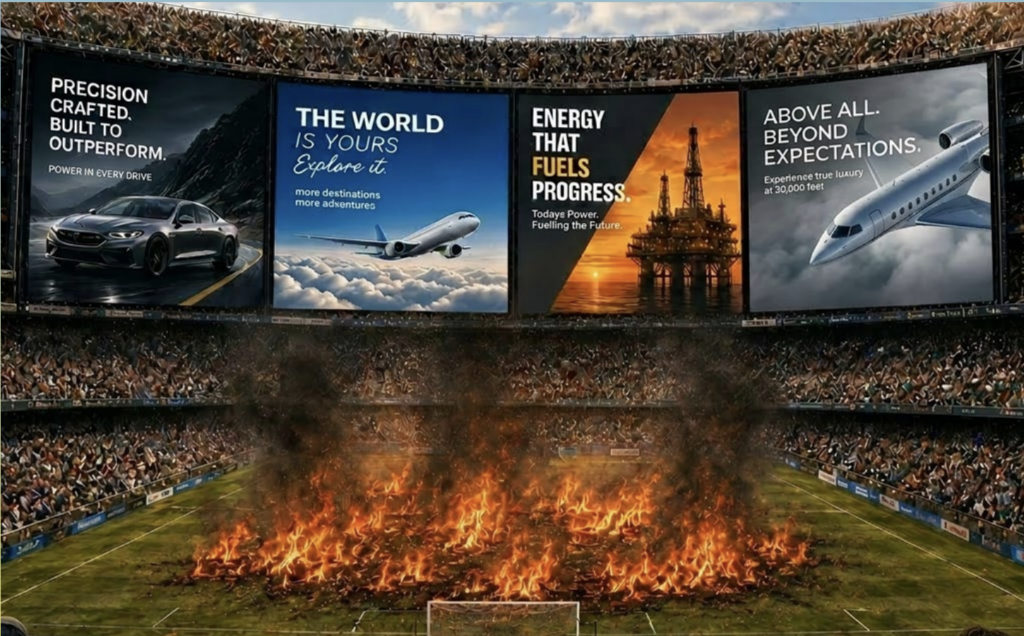
New analysis finds that FIFA’s deals with just four high-carbon sponsors – led by fossil fuel giant Aramco – could drive over four times the tournament’s own pollution from its logistics, operations and travel.
When England take to the pitch in Miami this week, they’ll be playing in around 33°C heat and 59% humidity. These conditions will feel like 44°C. Extreme heat, storms and wildfire smoke have shadowed this World Cup from the start. But a new briefing published by the New Weather Institute in collaboration with the Cool Down Network, Scientists for Global Responsibility and Fossil Free Football reveals that the tournament’s biggest climate impact does not come from the event itself, but the companies using it as a global advertising billboard for polluting products and lifestyles.
Four sponsors, 42 million tonnes
The briefing, Promoting Polluters: The FIFA World Cup’s Bigger Climate Cost, estimates that sponsorship deals with four of FIFA’s leading high-carbon commercial partners – Aramco, Qatar Airways, American Airlines and Hyundai-Kia – will generate 42 million tonnes of CO₂e in additional greenhouse gas emissions.
These companies spend hundreds of millions of dollars on sponsorship because advertising maintains and increases sales, while improving their reputation amongst billions of football fans around the world. The analysis assumes each company seeks a standard commercial return on its sponsorship spend, achieved through increased sales and when the product being sold is oil, flights or cars, those extra sales translate directly into extra emissions.
The headline findings of the briefing are:
- The four sponsorship deals are estimated to push potentially 42 MtCO₂e of additional emissions.
- Aramco alone accounts for a potential 34.7 MtCO₂e – 83% of the total sponsorship impact – making the world’s largest oil company by far the tournament’s biggest climate polluter.
- These “sponsored emissions” are around four times greater than the emissions from staging the tournament itself (estimated at approximately 9 MtCO₂e, including stadium operations, travel and logistics).
Put simply, FIFA’s commercial partnerships represent a larger climate impact than the World Cup itself, which is already a historically high polluting tournament.
How we worked it out
The briefing estimates “sponsored emissions” using sponsorship values, expected commercial returns, and each company’s greenhouse gas emissions intensity (Scope 1–3 emissions per unit of revenue). It follows the methodology first developed by the New Weather Institute in the UK and Sweden, and applied in its 2025 report FIFA’s Climate Blind Spot, which found the 2026 tournament on track to be the most polluting World Cup in the competition’s history.
What needs to happen
If FIFA is serious about protecting the future of football in a warming world, it should end its partnerships with major fossil fuel companies and exclude high-carbon sponsors from future tournaments.
Sport doesn’t need polluters’ money and the game’s governing bodies shouldn’t be renting out football’s unrivalled cultural reach to the companies heating the planet and making the game untenable. That’s why the organisations co-publishing the briefing are calling on clubs, events and sporting bodies everywhere to screen out polluting sponsors and sign the Fossil Free Declaration.
Read the full briefing: Promoting Polluters: The FIFA World Cup’s Bigger Climate Cost
For more on the climate story of this World Cup, see our media briefingand our guide to the Hot Six host cities.